
Episode 11 (Podcast) - Education Series (Part Two): Belonging by Design
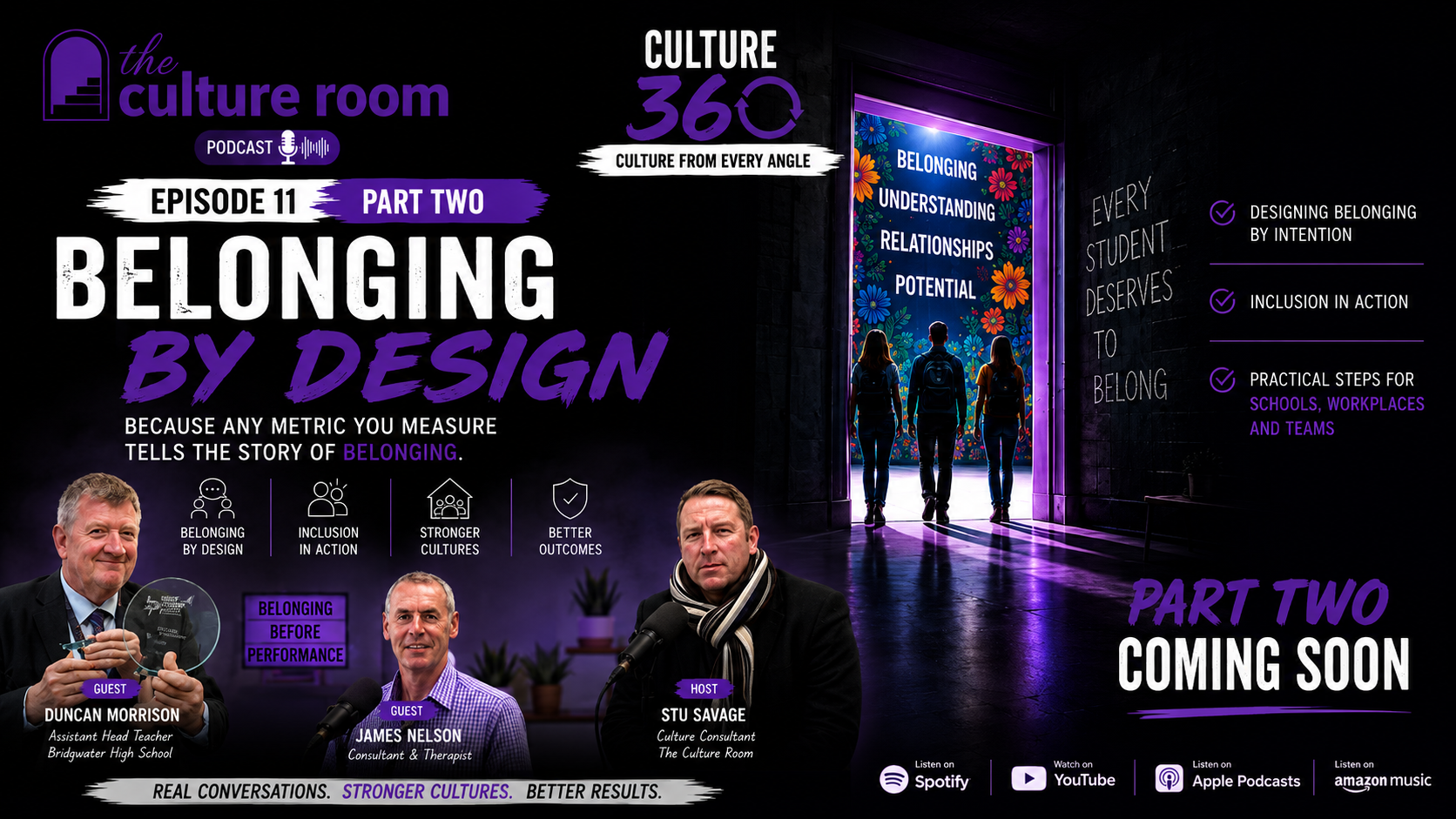
Episode 11 (Part Two): Belonging by Design
Belonging by Design
What does it actually take for a school to build belonging on purpose, rather than hope it happens by accident?
That is the question at the heart of Part Two of Culture 360's Education Series.
In Part One, “The School Wasn't Built for Me,” we explored what happens when the rules, routines and unwritten expectations of a school don't match every student's lived experience. That conversation asked why belonging matters.
This episode asks the harder question: how do you actually build it?
Host Stu Savage is joined by Assistant Head Teacher Duncan Morrison, back for his third appearance on the podcast, and by counsellor and education consultant James Nelson, returning after Episode 4's deep dive into primary emotions in the workplace. Between a senior leader's view from the school gate and a counsellor's view from inside the therapy room, the conversation moves from theory into practice.
Three Questions, Asked Silently, Every Single Day
Long before a lesson begins, every student walking through the school gates is quietly asking the same three questions.
● Am I safe here?
● Am I known here?
● Do I matter here?
For Duncan Morrison, these three questions are the real test of whether a school culture has been designed on purpose or left to chance. Get the answers right, and everything else — attendance, behaviour, achievement — starts to follow.
Trust Is a Currency, and Every Adult Is Spending It
One of the episode's most memorable ideas is what Duncan calls emotional currency: every interaction either deposits or withdraws trust from a relationship.
Enough trust in credit, and an adult can hold a student to account, redirect poor behaviour, or have a difficult conversation, because the relationship can absorb it. Without that credit, the same words land as an attack.
The rule of thumb is simple: every child should leave the building with more in the account than they arrived with. And it isn't only teachers making deposits or withdrawals. A bus driver, a coach, a receptionist — every adult a young person meets carries the same responsibility, whether they realise it or not.
Present in the Room, Absent in the Mind
Duncan describes a phenomenon he calls mental truancy: a student physically sitting in a classroom while their attention has already left the building. Increasingly, he links this to phones. Even switched off and out of sight, the mere possibility of a buzz in a pocket is enough to pull focus away from the lesson.
His school is introducing phone pouches and gate-side screening for 1,700 students this September. It's a significant operational undertaking. But in early conversations with students, many privately admitted something schools rarely hear out loud: relief at not having to manage the social pressure of carrying a phone at all.
Behaviour Is Never Just Behaviour
This idea, first raised in Part One, is explored in far more depth here through James Nelson's counselling lens. Anxiety, disconnection and identity confusion rarely announce themselves directly. They surface first as behaviour — as a student who has stopped trying, shut down, or started acting out.
James describes how much of his work with students starts with something surprisingly basic: helping them simply name what they're feeling in the first place. Many can't, at least not at first. Once trust and confidentiality are properly established, though, what young people are willing to share often surprises the adults around them.
Both guests return to the same warning: trust, once broken, is extraordinarily hard to rebuild. And the resourcing behind this work is thinner than most people realise — New Zealand's counselling bodies recommend one counsellor per 400 students; Duncan describes a single specialist covering 1,700 pupils in his own school, against CAMHS waiting lists in England running past twelve months.
A Silent Classroom Is Not the Same as a Safe One
Perhaps the sharpest distinction in the whole conversation: compliance is not belonging. Thirty students sitting quietly, following every instruction, can just as easily be thirty students sitting in anxiety — behaving well because they're afraid of what happens if they don't.
Duncan's own approach to behaviour management, honed over two decades and now taught to trainee teachers, reframes the goal entirely: not children who are scared of you, but children who are scared to let you down. One is built on fear. The other is built on trust. Only one of them moves mountains.
The Rules Nobody Writes Down
Building directly on Part One's idea of a hidden curriculum, Duncan describes belonging as fluency in a game's unwritten rules — codes of conduct that every insider simply absorbs, and every outsider has to guess at. For a student navigating an unfamiliar culture, or a home life that doesn't match the school's expectations, that's an invisible and often unfair barrier to fitting in.
You Don't Get Graded on Belonging — But It's in Everything Else
Belonging doesn't appear as its own line in an inspection report, and Duncan argues that's exactly the point. It doesn't need to, because it's the thread running underneath every metric a school is already judged on.
● Attendance and punctuality
● Behaviour and exclusion data
● Attainment and outcomes
● Bullying and safeguarding logs
● The feel of a corridor, a classroom, a canteen at lunchtime
Every one of those numbers, in Duncan's words, is telling the story of belonging in that school — whether anyone is calling it that or not.
The Simplest Strategies Work Best
For all the complexity underneath it, the practical fixes both guests describe are refreshingly unglamorous. A teacher who built a “yellow pages of expertise” so every student, regardless of academic ability, knew what they could offer the group. A teacher who used a deck of cards to form random groupings, deliberately breaking up existing friendship circles so no one was left isolated by default.
The common thread, as James puts it, was never anything earth-shattering. It was students simply feeling that a teacher hadn't singled them out — and hadn't mistaken their silence for agreement.
Final Thoughts
Both guests, asked what they'd want to see twelve months from now, land on the same idea that has carried through both episodes of this series: belonging isn't a soft add-on sitting alongside literacy, numeracy and results. It's the foundation underneath all of them.
Fixing it doesn't require a new initiative or another line in the strategic plan. It requires schools to design, deliberately, for safety, recognition and trust — at the gate, in the corridor, and in every classroom in between.
The guiding principle, as Duncan puts it, hasn't changed in fifty years: an adult who can make a child feel safe, known and important in a room is doing the most important job in the building.
In case you missed it…
The Culture 360 Blog & Podcast (Ep 4): Going Underground — Working with Primary Emotions and Navigating Workplace Dynamics. Before James Nelson joined the conversation on belonging, he sat down with The Culture 360 Podcast to explore the primary emotions underneath workplace behaviour — and why understanding what sits beneath the surface changes everything about how we lead and support people.